
What Happens After We Die? Washingtonian, 2025
AT THE EASTERN EDGE of downtown Charlottesville — past the red-brick pedestrian mall with its bookstores and fudge shops and busking guitarists, beyond the incongruously modern amphitheater, just as the road begins to slope downhill toward the train tracks and then out toward Monticello — sits an utterly nondescript condo building.
I was there looking for the site of some highly unusual research conducted within the University of Virginia’s medical school. It’s mind-bending, norm-challenging work that explores the metaphysical—which is why I’d expected something a little more mystical. A spiral staircase, an owl, a crystal ball. The divination tower at Hogwarts. Certainly not a mid-rise straight out of Anywhere, USA. Only there it was, visible through the glass front door: a placard in the lobby reading “Division of Perceptual Studies.”
Mary Peltola Has Carved Out Her Own Space in Washington, Washingtonian, 2024
IN LATE JULY, Mary Peltola scrambled to change her travel plans. The first-term Democratic representative from Alaska had just returned to DC after a trip home to help her family put up salmon for the winter: smoking, salting, drying, canning, and freezing fish for the long, cold months ahead.
She’d missed several votes, drawing criticism from conservative groups, and now — after just five days back in the capital — she was packing again.
Leaders in the House of Representatives had canceled the following week’s agenda, starting summer recess early. For Peltola, that meant another exhausting journey, about 4,000 miles from start to finish. There would be a flight to Seattle, another to Anchorage, then one more, on a cramped, narrow-body jet to Bethel, a town of 6,276 on the banks of the Kuskokwim River in western Alaska.
Peltola’s trip is more than 1,500 miles longer than the distance the representative from the next-farthest-flung district travels. She jets through five time zones, often facing delays, which means that by the time she reaches her bed, it can be the middle of the night on the Yukon Delta. Back in Washington, the sun has already risen.
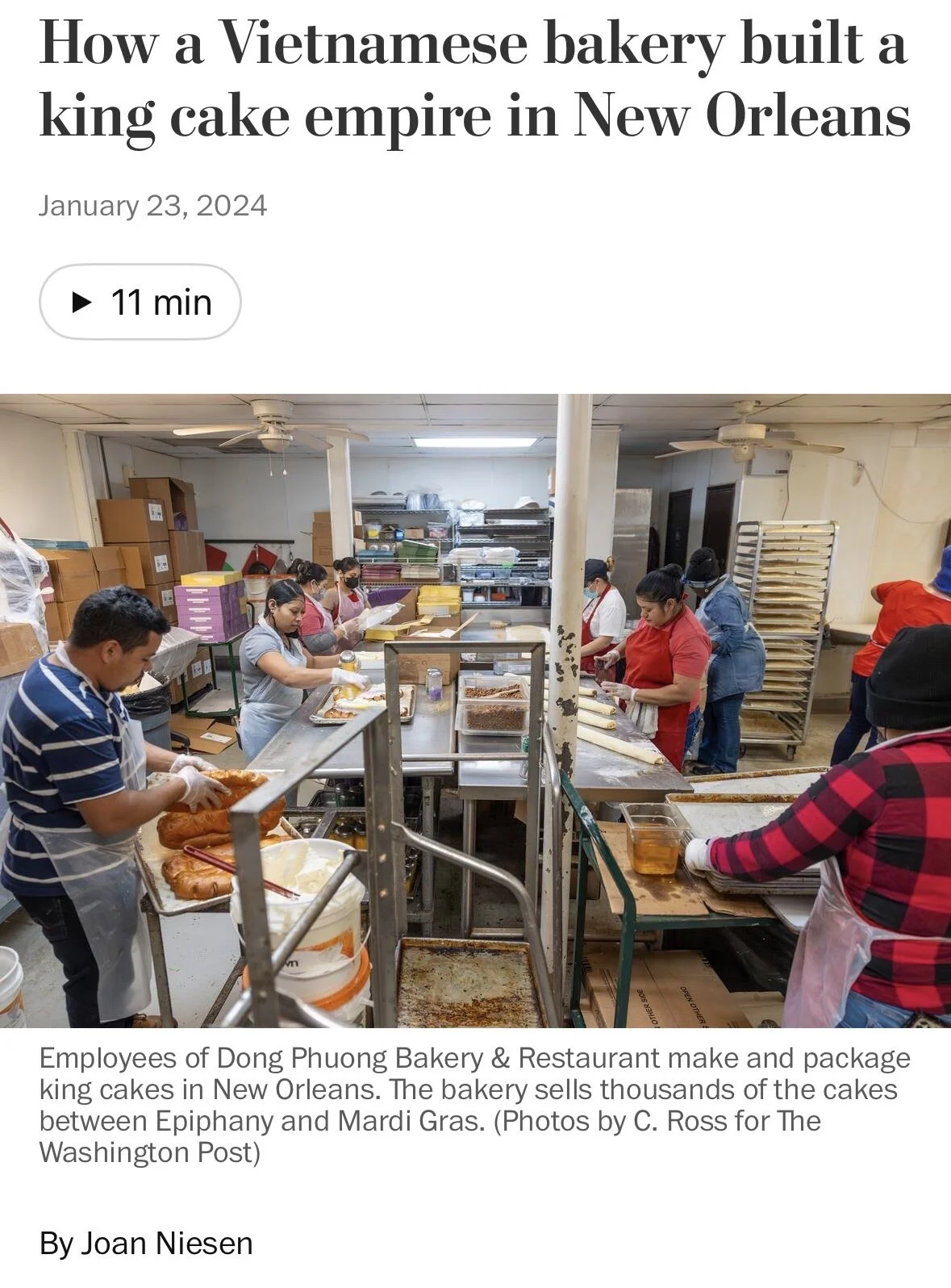

How a Vietnamese bakery built a king cake empire in New Orleans, the Washington Post, 2024
IT STARTED WITH a handful of requests and 100 cardboard boxes.
Over the years, Huong Tran’s bakery, Dong Phuong, had developed a reputation for making the best brioche and mooncakes in the neighborhood. So it was only natural that customers began to ask about king cakes each winter.
A child needed one to bring to school. A host wanted to serve one at a party. Dong Phuong, which opened in 1982, had never offered the traditional Mardi Gras pastry, but in 2008, Tran decided to experiment. She and her daughter, Linh Tran Garza, developed a recipe, and they figured 100 boxes would be more than enough.
Garza can remember her reaction when the bakery sold its 100th cake. She was excited — and that was that. Dong Phuong shut down king cake production for the season.
Today, Tran and Garza rule a Carnival empire out of a squat, brick building on the side of a four-lane highway about 10 miles northeast of the French Quarter. In Dong Phuong’s industrial kitchen, crews of bakers finish about 1,600 king cakes per day, beginning with the first batch of dough on Dec. 31 and finishing on Lundi Gras — the day before Fat Tuesday — which this year falls on Feb. 12. They whip glossy, white frosting in mixers the size of baptismal fonts and fold and roll butter into dough at a breakneck pace. They bag cake after cake, filling orders for pickup and preparing boxes to ship as far as Canada and Hawaii.
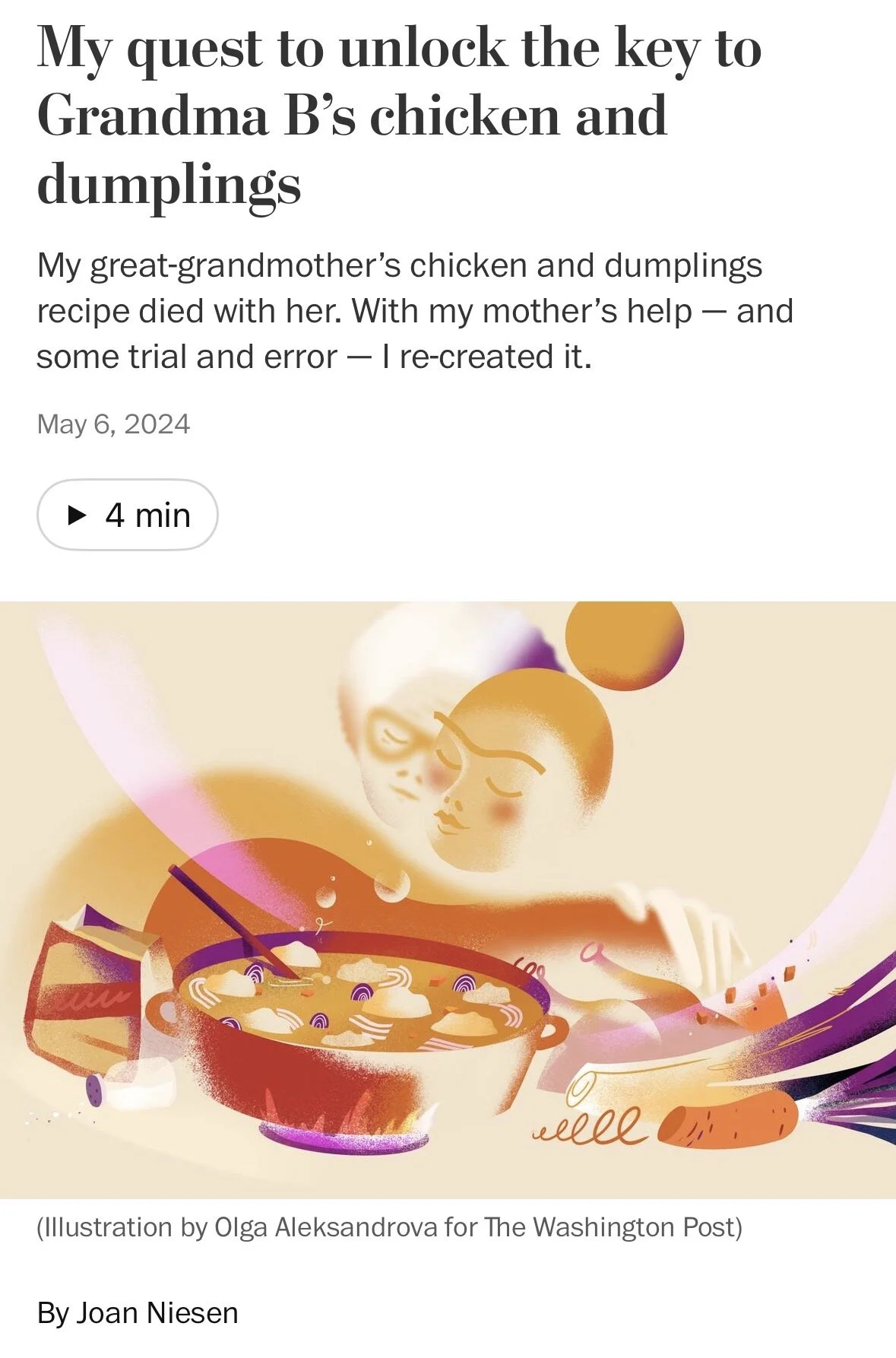
My quest to unlock the key to Grandma B’s chicken and dumplings, the Washington Post, 2024
MY GREAT-GRANDMOTHER WAS A ROCK of a woman, a 5-foot-nothing field general in false teeth and pin curlers. She set things in order and made things right and told you exactly what you were doing wrong. She was always, unceasingly, maniacally doing: the laundry, the yardwork, the dusting and, of course, the cooking.
Her name was Evelyn Baldridge, but to me, she was Grandma B. I was lucky enough to know her for almost 13 years, which meant that, when she died, I was just old enough to understand how different she was from almost every other old lady I’d ever met. For starters, she never in all her 95 years seemed particularly old. She couldn’t drive or swim. She didn’t have a husband, and although she’d had one once, I understood that was a problem she’d fixed right around the time the Great Depression hit. She lived in a house in Farmington, Mo., the size of a woodshed, where my dad’s high school portrait was the featured piece of artwork and the curtains smelled like bacon grease.
Grandma B was always frying something: bacon or chicken or occasionally squirrel. Mornings, she would disappear into a cloud of flour and emerge with biscuits while a pot of gravy bubbled on the ancient stove. Breakfast stretched into lunchtime, and then maybe, if I was lucky, she’d spend the afternoon making chicken and dumplings.
It was the one dish she made that I truly enjoyed. I was not a little girl who would gnaw a crispy chicken leg down to the bone. I was scared of dark meat, of cartilage, of accidentally nibbling something I should not. Gravy, with all its flecks and specks and who-knows-whats, made me shudder. But chicken and dumplings? I’d scoop seconds.
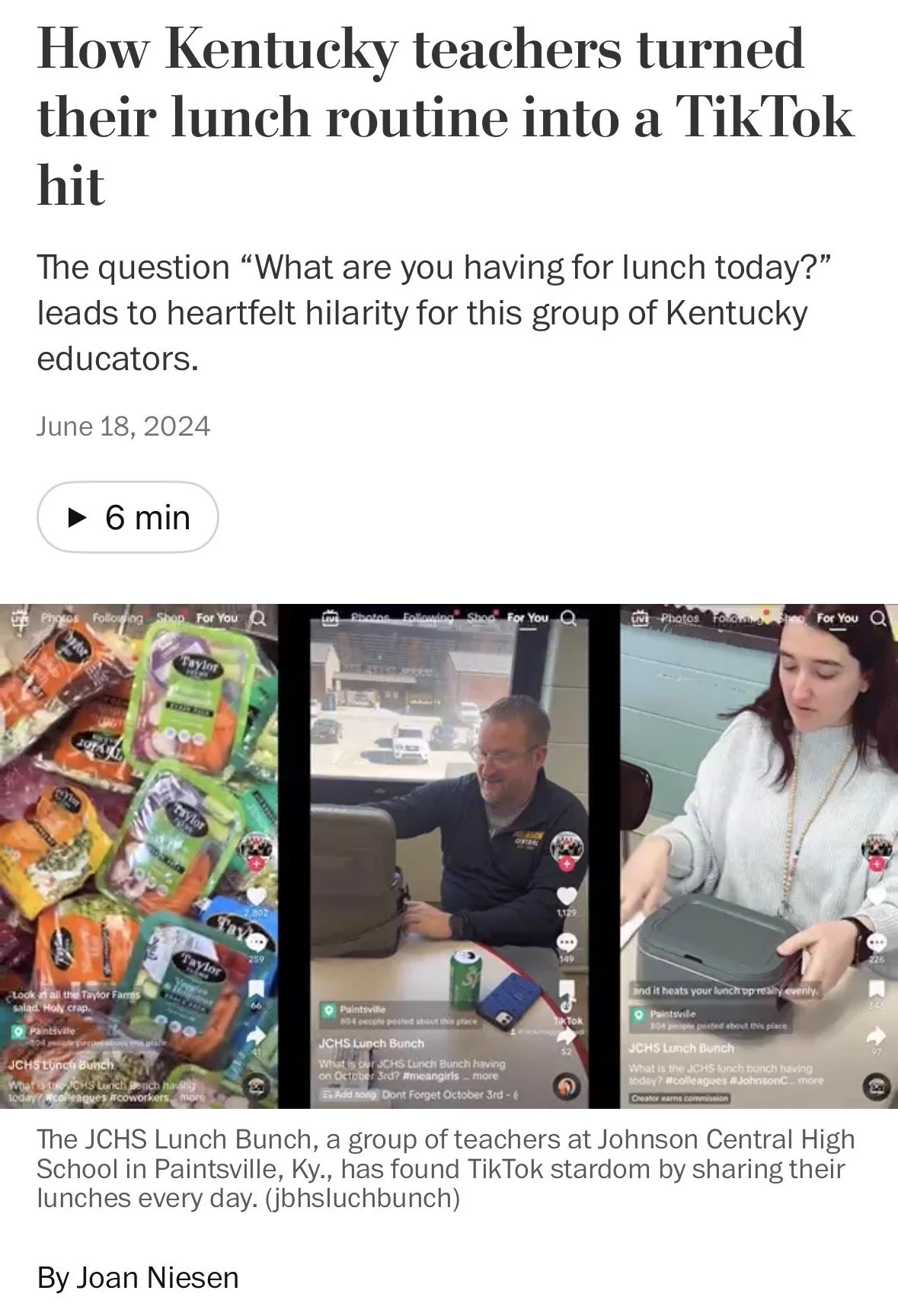
How Kentucky teachers turned their lunch routine into a TikTok hit, the Washington Post, 2024
THE CAMERA ZOOMS IN on a pile of bagged salads, dozens of them, stacked high on a table. There’s an assortment of flavors — citrus crunch, Nashville hot, Buffalo ranch — plus a handful of veggie snack packs with guacamole and hummus. Underneath it all, there’s a woman.
Mellanie Hicks, an instructor at Johnson Central High School, lies flat, mouth agape. The table is actually two desks pushed together. And when the camera pans over her face, Hicks blinks rapidly and smiles. “Surprise, surprise!” she sings, emerging from the leafy mess. Hicks is a member of Johnson Central High’s best-known club, which is only open to teachers and staff at the Paintsville, Ky., school.
The JCHS Lunch Bunch has been eating together during the school’s first lunch period, at 11:05 a.m., for years. And for years, it was nothing more than a tightknit group of friends at a small-town high school in Eastern Kentucky. Until September. That’s when Nicki Caudill, a biology teacher and testing coordinator, had a spur-of-the-moment idea.